
How the words are built
Almost every clinical term is assembled from three kinds of piece:
|
Part |
Position |
What it does |
Example |
|
Prefix |
Front |
Modifies — where, when, how much |
peri- (around) |
|
Root |
Middle |
The subject — usually a body part |
cardi (heart) |
|
Suffix |
End |
What is happening to it |
-itis (inflammation) |
peri + cardi + itis = pericarditis
around + heart + inflammation = inflammation around the heart
That is the whole system. Everything else is detail.
Read from the end backwards
This is the single most useful habit, and it is not how people naturally read.
Start with the suffix, because it tells you what kind of word this is — a condition, a procedure, an inflammation, a measurement. Then the prefix. Then the root last.
hepatomegaly → -megaly (enlargement) → hepat (liver)
= enlargement of the liver
bradycardia → -ia (condition) → brady- (slow) → card (heart)
= condition of a slow heart
Reading front to back, you get stuck on the root. Reading back to front, the shape of the word appears immediately.
The combining vowel
You will see roots written with a slash and an o, like cardi/o or gastr/o. That o is a combining vowel, and it exists to make words pronounceable.
Two rules cover nearly everything:
- Keep the vowel when the next part starts with a consonant — cardi/o + -megaly = cardiomegaly
- Drop it when the next part starts with a vowel — cardi/o + -itis = carditis
Keep it between two roots regardless — gastr/o + enter/o + -logy = gastroenterology.
The parts worth learning first
Prefixes
|
Prefix |
Meaning |
Prefix |
Meaning |
|
a- / an- |
without |
hyper- |
above, excessive |
|
brady- |
slow |
hypo- |
below, deficient |
|
tachy- |
fast |
peri- |
around |
|
dys- |
difficult, painful |
intra- |
within |
|
poly- |
many |
inter- |
between |
|
hemi- |
half |
sub- |
under |
Roots
|
Root |
Meaning |
Root |
Meaning |
|
cardi/o |
heart |
nephr/o |
kidney |
|
pulmon/o |
lung |
hepat/o |
liver |
|
gastr/o |
stomach |
derm/o |
skin |
|
enter/o |
intestine |
oste/o |
bone |
|
neur/o |
nerve |
hem/o |
blood |
|
my/o |
muscle |
cyt/o |
cell |
Suffixes
|
Suffix |
Meaning |
Suffix |
Meaning |
|
-itis |
inflammation |
-ectomy |
surgical removal |
|
-osis |
abnormal condition |
-otomy |
cutting into |
|
-emia |
blood condition |
-ostomy |
creating an opening |
|
-megaly |
enlargement |
-scopy |
visual examination |
|
-pathy |
disease |
-algia |
pain |
|
-penia |
deficiency |
-pnea |
breathing |
Decoding practice
Work these back to front:
|
Term |
Parts |
Meaning |
|
Nephrolithiasis |
nephr/o + lith + -iasis |
condition of kidney stones |
|
Cholecystectomy |
chole + cyst + -ectomy |
surgical removal of the gallbladder |
|
Leukocytopenia |
leuk/o + cyt/o + -penia |
deficiency of white blood cells |
|
Tachypnea |
tachy- + -pnea |
rapid breathing |
|
Osteomyelitis |
oste/o + myel + -itis |
inflammation of bone and marrow |
|
Polyneuropathy |
poly- + neur/o + -pathy |
disease of many nerves |
None of those needed to be memorized. Each one was assembled from parts in the tables above.
The pairs that cause errors
Some word parts look alike and mean opposite or very different things. These are worth learning deliberately, because the difference is clinically significant.
|
These |
Not these |
The difference |
|
hyper- (above) |
hypo- (below) |
Opposite. Hyperglycemia and hypoglycemia are opposite emergencies. |
|
-otomy (cutting into) |
-ostomy (creating an opening) |
A tracheotomy is an incision; a tracheostomy creates a lasting opening. |
|
-ectomy (removing) |
-otomy (cutting into) |
One takes it out, one opens it up. |
|
inter- (between) |
intra- (within) |
Intercostal is between the ribs; intramuscular is within the muscle. |
|
peri- (around) |
para- (beside) |
Pericardial is around the heart; parathyroid is beside the thyroid. |
|
ab- (away from) |
ad- (toward) |
Abduction moves away from the body; adduction moves toward it. |
Abbreviations, and the ones you must not use
Charts are full of abbreviations, and most are learned by exposure. But some are prohibited, because they have caused medication errors.
The Joint Commission maintains an official Do Not Use list. Long-standing entries include:
|
Do not use |
Why |
Write instead |
|
U, u |
Mistaken for 0, 4 or cc |
unit |
|
IU |
Mistaken for IV or the number 10 |
international unit |
|
Q.D., QD, qd |
Mistaken for each other or QID |
daily |
|
Q.O.D., QOD |
The period is read as an I |
every other day |
|
Trailing zero (1.0 mg) |
The decimal is missed — tenfold error |
1 mg |
|
No leading zero (.5 mg) |
The decimal is missed — tenfold error |
0.5 mg |
|
MS, MSO4, MgSO4 |
Morphine and magnesium confused |
write the drug name in full |
The leading and trailing zero rules are the two most likely to catch a student. A missed decimal point is a tenfold dosing error, which is why the rule exists rather than being a style preference.
Confirm the current list with your institution — it is reviewed periodically and some facilities prohibit more than the minimum.
How long it actually takes
Learning to decode takes weeks, not months, because you are learning a system rather than a vocabulary. A few hundred word parts, studied a handful at a time, unlocks most of what you will meet.
What takes longer is fluency — reading a note and understanding it without stopping to break words apart. That comes from exposure, and it builds on its own once you are in clinicals.
- Learn parts in small batches, ten or fifteen at a time
- Practice by decoding, not by reciting — take a term you do not know and break it down
- Learn by body system, so terms sit alongside the anatomy they describe
- Read real documentation when you can; it is where the terms actually live
Free word parts reference
We made a printable reference sheet: the most common prefixes, roots and suffixes, the combining vowel rules, the confusable pairs, and the Do Not Use abbreviations.
Free, no purchase required.
Where this fits
Medical terminology is one of the three things worth learning before nursing school starts, alongside dosage calculations and dimensional analysis. All three are assumed from the first week of lectures, and none of them is difficult — they just take time you will not have once the semester is running.
Our Medical Terminology Workbook is 232 pages organized by body system, so terminology is learned in the context where you will use it, with abbreviations, the Do Not Use list, and how terms appear in SOAP notes and documentation.
Written by Jennifer Cheung, MSN, RN, CCRN. Abbreviation policies vary by institution — always follow your facility's approved list.
Featured Products
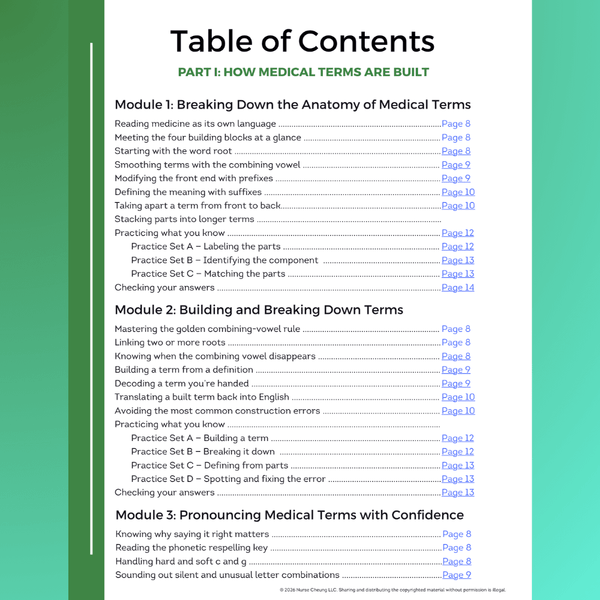
Medical Terminology Workbook
232 Pages · Decode Any Clinical Term
Medical terminology looks like a foreign language because it mostly is. This 232-page workbook teaches you to break terms into their roots, prefixes, and suffixes so you can work out...
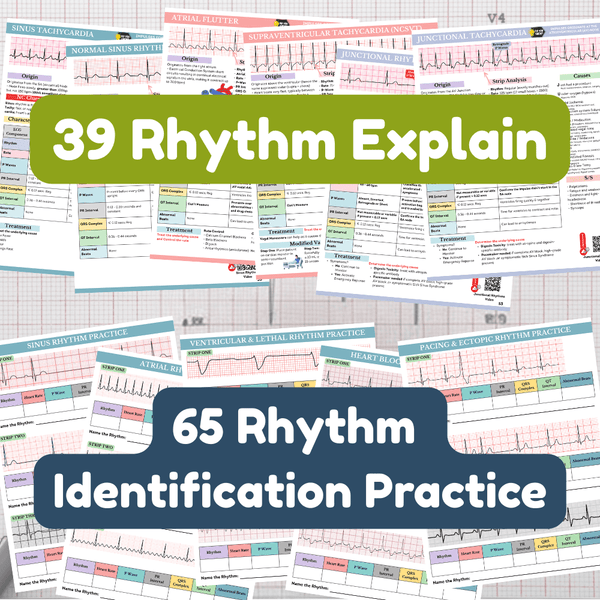
EKG & Dysrhythmia Interpretation Guide
111 Pages · 65 Practice Strips · ECG Rhythms & ACLS
Stop memorizing rhythm names and start reading the electrical story behind them. This 111-page EKG guide (also written ECG) teaches a repeatable method for reading any strip: rate, rhythm, P...