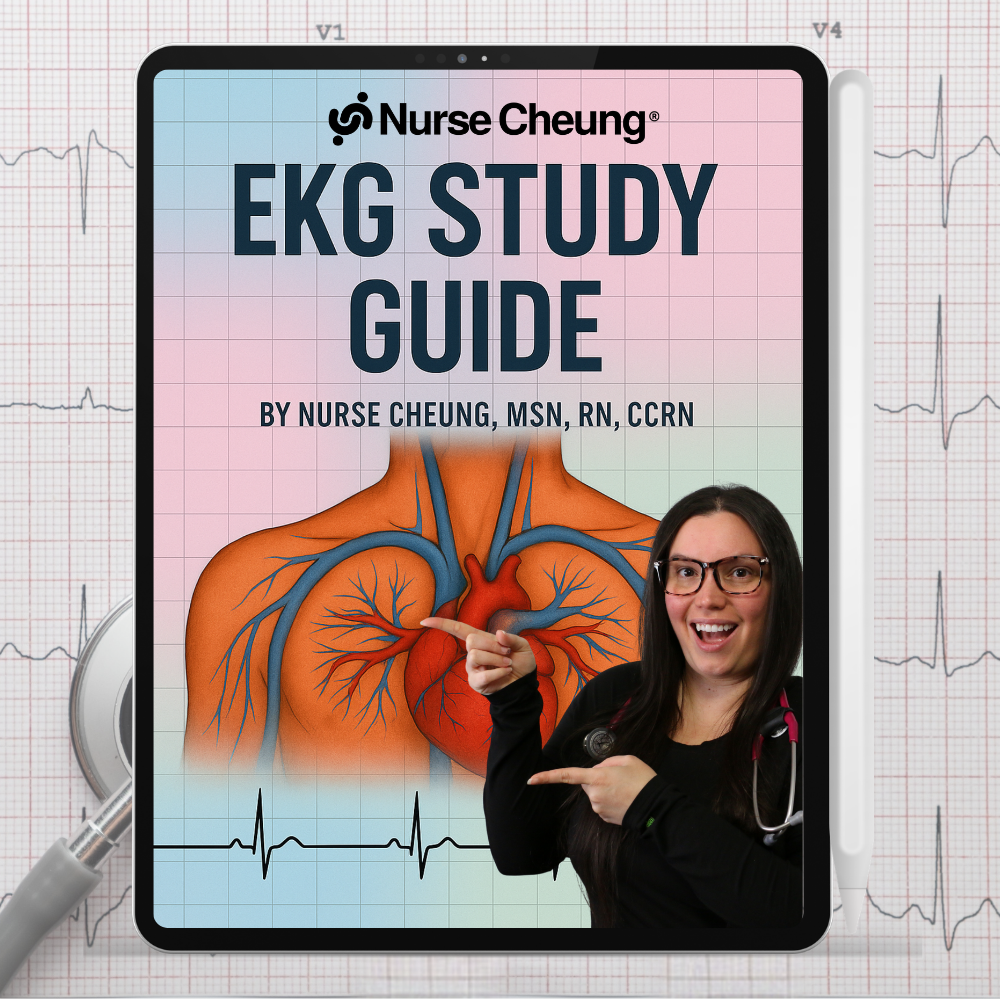
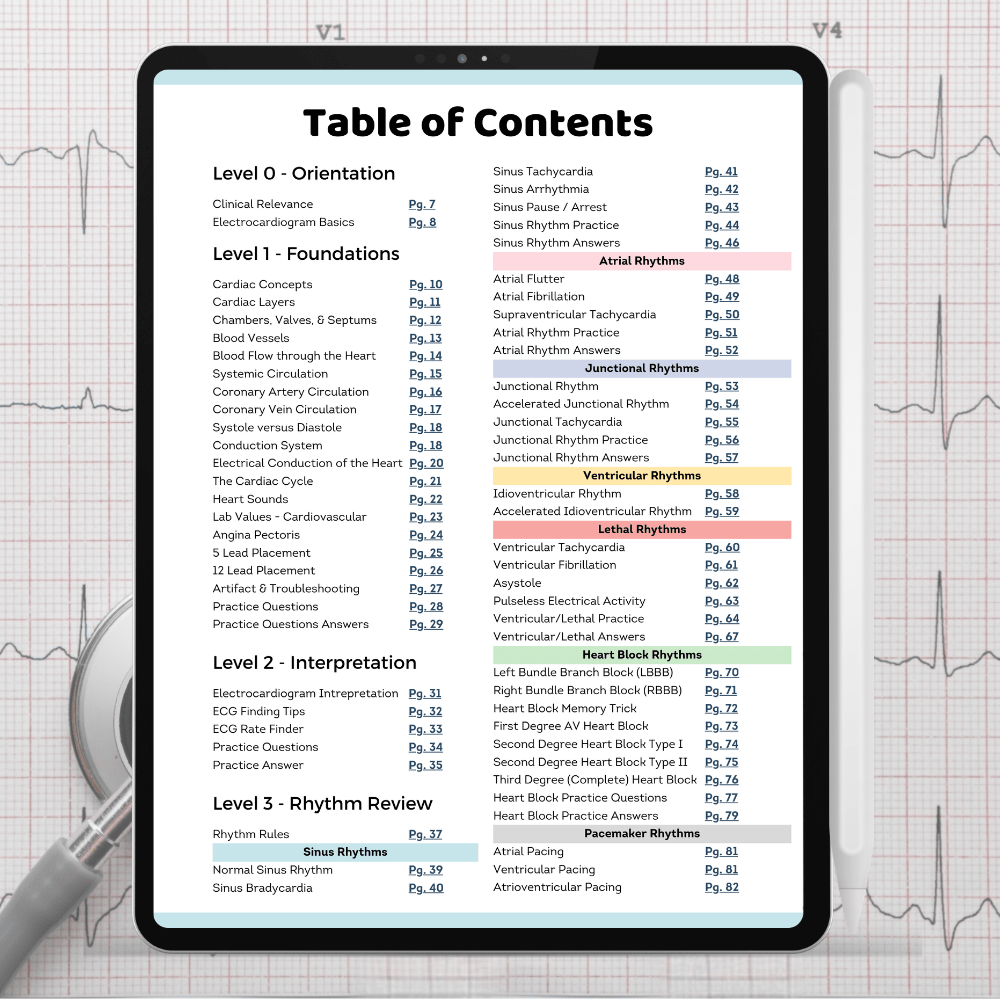
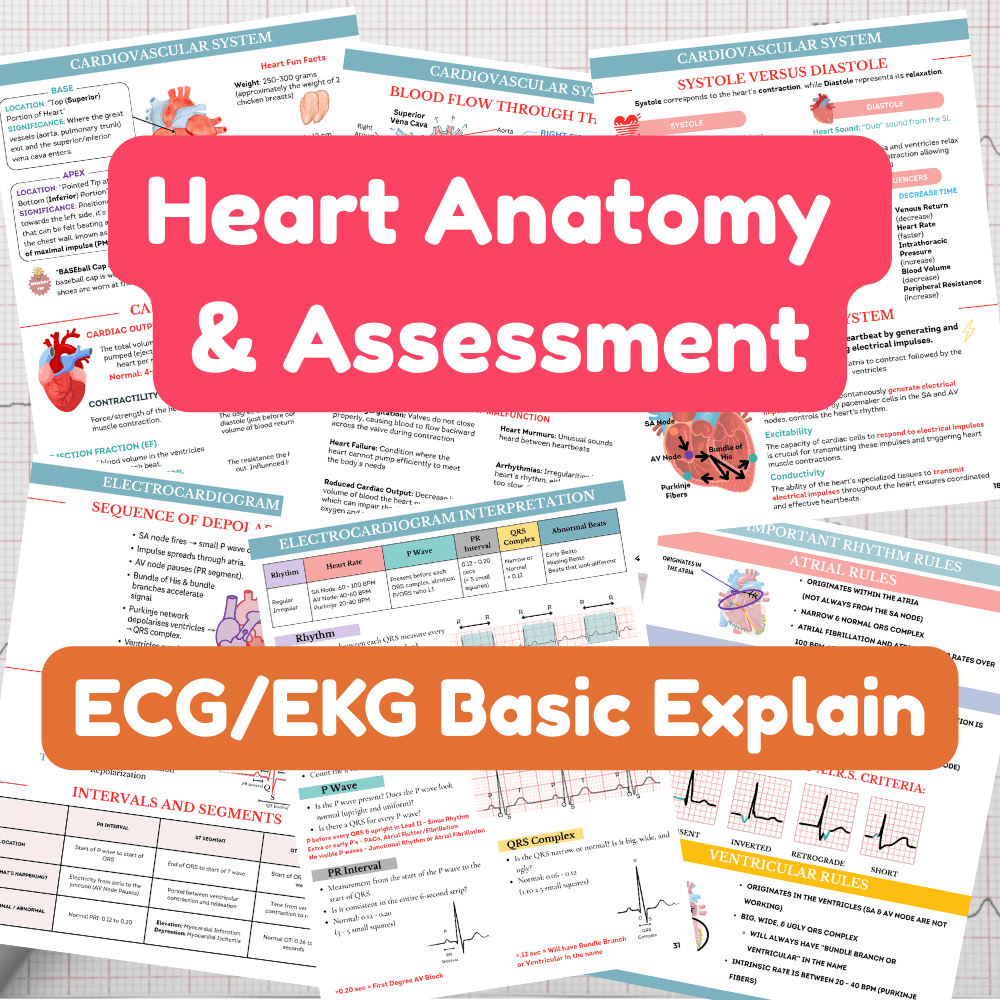
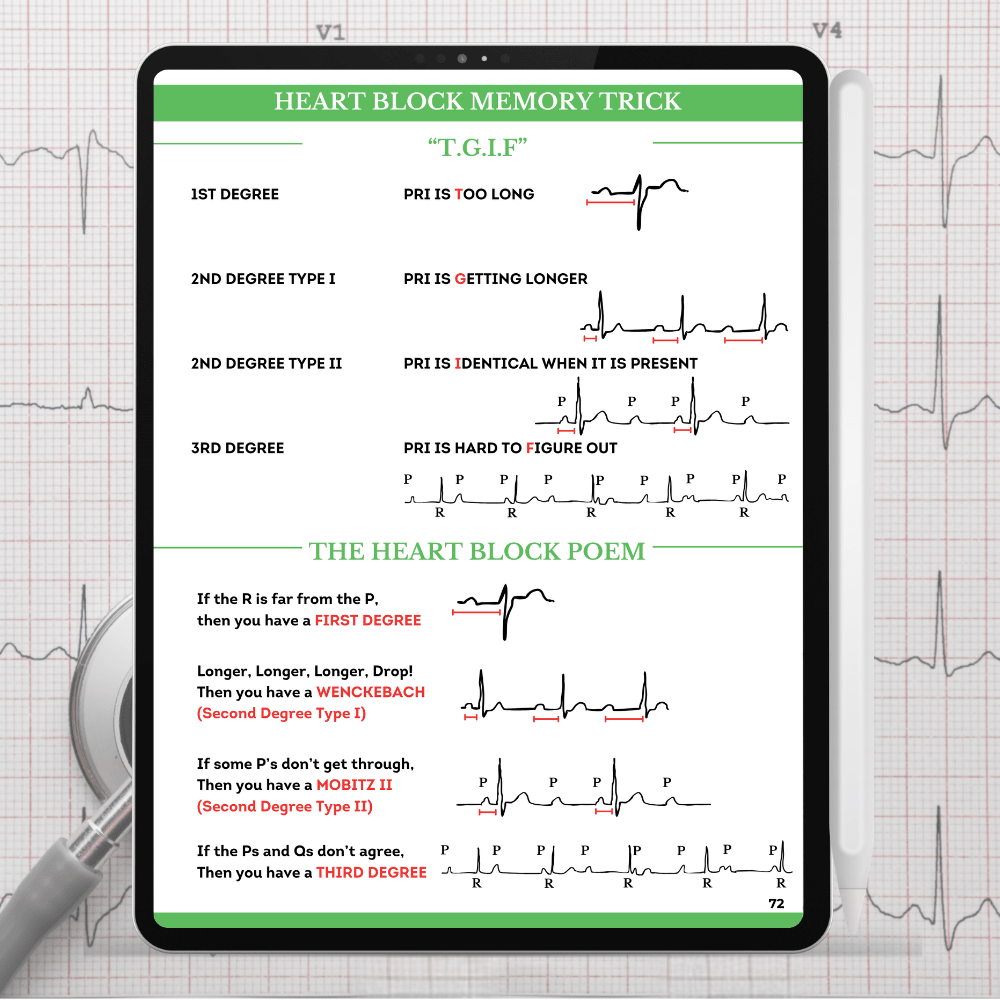
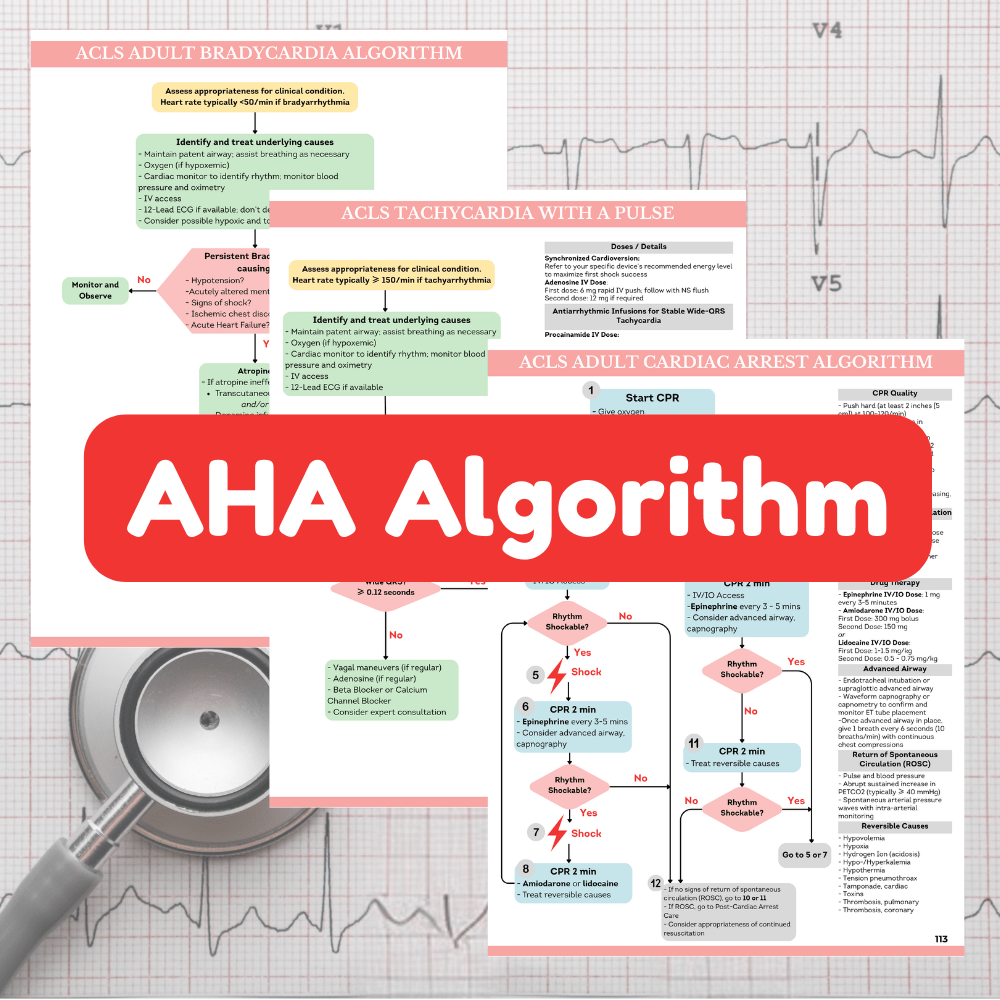
EKG & Dysrhythmia Interpretation Guide
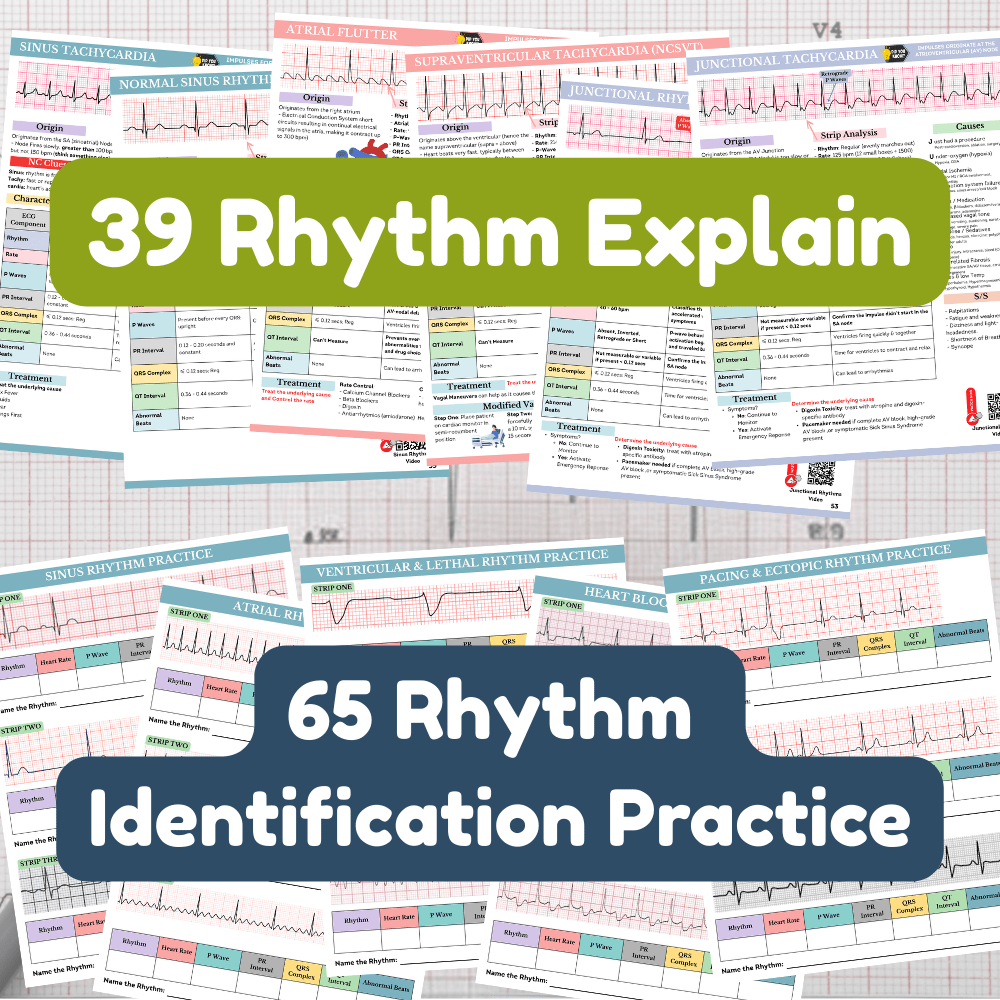
111 Pages · 65 Practice Strips · ECG Rhythms & ACLS
Best Suited for...
- Nursing students heading into telemetry or critical care clinical
- Students who can name rhythms but freeze when handed an actual strip
- Anyone preparing for a dysrhythmia competency or check-off
- Working nurses who want a structured refresher
- ACLS candidates and NCLEX preppers
This is a digital PDF download. You'll receive immediate access after checkout so you can start studying instantly.
Buy it with:
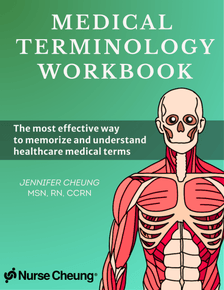
Medical Terminology Workbook
232 Pages · Decode Any Clinical Term
Stop Brute-Force Memorizing. Start Decoding the Language of Healthcare. Medical terminology looks like a foreign language because it mostly is one—two of them, actually, stitched together from Greek and Latin....
- Format: Digital PDF Download.
- Delivery: Instant access via email after purchase.
- Compatibility: Read on any tablet, laptop, or desktop.
- Printable: Yes, strictly for personal study use.
What's Included
This digital PDF study guide is organized into four focused sections aligned with the ATI TEAS 7 content areas:
Relevant Videos
Take your review a step further by learning directly with Nurse Cheung. Our video sessions break down high-yield topics into clear, easy-to-digest lessons designed to make active recall second nature. Click through to watch and sharpen your reasoning today!


Frequently Asked Questions
The ATI TEAS is used by many healthcare programs as part of their admissions process. While it is most commonly associated with nursing programs, it is also required by a variety of allied health programs.
Learn what will otherwise cost you time in your first semester: dosage calculations, anatomy/physiology, and medical terminology. Those three come up immediately and are entirely learnable in advance. Setting up how you will study early matters more than reading ahead in a textbook. Bootcamp Phase I covers the pre-semester preparation, and Phase II picks up from your first day.
Expect the volume to be the shock, not the difficulty of any single topic. The pace is faster than prerequisites, exam questions stop having one obviously correct answer, and clinicals add a second full commitment on top of coursework. Most students find their previous study methods stop working, which is normal rather than a sign they do not belong. Bootcamp Phase II covers learnable skills and prioritization frameworks like ABCs, Maslow’s, and ADPIE that decrease the initial shock most students experience in their first semester.
Active recall applied to mechanisms rather than facts. Nursing exams ask what you would do and why, so studying by rereading notes prepares you for the wrong task. Work from a consistent framework — what the concept is, what you would assess, what you would do, and how you would evaluate it — and practice questions become far more predictable.
Learning to decode terms takes weeks, not months, because you are learning a system rather than a vocabulary. Break words into their parts instead of memorizing them whole. Nearly every clinical term is built from a root plus a prefix or suffix, and those components repeat constantly across body systems. Learning the components once gives you access to hundreds of terms at a time. Nurse Cheung’s Medical Terminology Workbook gives you the tools you need to create repeatable systems of learning.
Determine the rate. Decide whether the rhythm is regular or irregular. Check whether P waves are present, upright, and one before each QRS. Measure the PR interval. Measure the QRS width. Those five answers narrow almost any strip to a small number of possibilities before you name anything. Study enough practice strips that the method stops requiring conscious effort. Most students need dozens rather than a handful, because recognition comes from volume. Working strips in mixed order, rather than grouped by rhythm type, is what tests whether you can actually do it. Nurse Cheung’s ECG Study Guide provides 65 practice strips in total: drills after each module, plus a 35-strip final exam.
No. This is a digital PDF download. You will get a download link on screen immediately after checkout and by email, so you can start studying within a couple of minutes.
Yes. You can print the whole guide or individual sections for your own study use only.
After checkout, you will see a download link on screen and receive an email with access instructions. The link stays active for six months, and you can request a fresh one any time after that.