
What the TEAS actually is
TEAS stands for Test of Essential Academic Skills. It is written and administered by ATI — Assessment Technologies Institute — and programs use it to assess whether an applicant is academically ready for the coursework ahead.
The current version is TEAS 7. You will see it called the TEAS, the ATI TEAS, and the TEAS 7 — these all refer to the same exam.
It is not an IQ test or an aptitude test. It is a test of high school level reading, math, science and English, applied under time pressure.
Who has to take it
Nursing programs at every level — LPN, ADN, BSN and accelerated BSN — commonly require it. So do many allied health programs, including dental hygiene, radiologic technology, respiratory care and physical therapist assistant.
Some programs use the HESI A2 instead. A few use neither. Your program decides, so check before you prepare for the wrong exam.
It is worth knowing why programs weight it so heavily: admission is capacity-limited rather than merit-limited. ATI notes that around 30% of qualified applicants are turned away from ADN, diploma and BSN programs. When there are more qualified applicants than seats, an objective score becomes a way to rank them.
The structure
170 questions, 209 minutes, four sections, taken in a fixed order.
|
Section |
Questions |
Time |
Share |
|
Reading |
45 |
55 minutes |
26% |
|
Mathematics |
38 |
57 minutes |
22% |
|
Science |
50 |
60 minutes |
29% |
|
English & Language Usage |
37 |
37 minutes |
22% |
|
Total |
170 |
209 minutes |
100% |
Of the 170 questions, 150 are scored and 20 are unscored pretest items being trialed for future exams. You cannot tell which is which, so treat every question as though it counts.
There is an optional 10-minute break after the Mathematics section, before Science. Take it — Science is the longest section and it arrives when you are already two hours in.
What each section covers
|
Section |
Content |
|
Reading |
Key ideas and details, craft and structure, integration of knowledge, and reading information from charts, labels and directions |
|
Mathematics |
Numbers and algebra, measurement and data — fractions, ratios, equations, unit conversion, geometry and statistics |
|
Science |
Anatomy and physiology, biology, chemistry, and scientific reasoning |
|
English |
Conventions of standard English, knowledge of language, and vocabulary acquisition |
Science is the largest section and the one students lose the most points on. Within it, anatomy and physiology carries 18 scored questions — the single largest topic anywhere on the exam.
How the exam behaves
Several rules catch students out because they differ from most exams:
|
Rule |
What it means for you |
|
Sections are timed separately |
Finishing Reading early does not give you extra minutes for Science |
|
Sections lock once submitted |
You cannot go back to a previous section |
|
No penalty for guessing |
Never leave a question blank |
|
A calculator is provided |
Basic four-function, on screen, in the Mathematics section only — you cannot bring your own |
Question types
It is not all multiple choice. TEAS 7 uses several formats:
- Multiple choice — one correct answer
- Multiple select — more than one correct answer, and you must get all of them
- Fill in the blank — you type the answer
- Ordered response — arrange items into the correct sequence
- Hot spot — click the correct area of an image
Practice with these formats before test day. Meeting an ordered response question for the first time in a timed exam costs you minutes you do not have.
How it is scored
There is no pass mark on the TEAS. ATI reports your score; each program decides what it will accept.
Your report shows a total score, a score for each of the four sections, a breakdown by sub-topic, and a proficiency level. It also shows how you compare to other test takers.
What programs generally look for varies by program type:
|
Program type |
Score generally needed |
|
LPN / LVN programs |
50–60% |
|
RN programs (ADN, BSN) |
80% and above |
|
Competitive programs and competitive states |
90% and above |
|
Radiologic technology |
High 80s — seats are limited |
These reflect what our students report. Every program sets its own requirement, so check the ones on your list.
The sub-topic breakdown is the most useful part of the report and the part most students never open. If you retake, it tells you exactly what to study.
Where and how to take it
There are four routes, and your program may prefer or require one:
- In person at your institution, proctored by them
- In person at a PSI testing center
- Online at home, proctored remotely by ATI
- Online at home, proctored remotely by your institution
Registration runs through your ATI account at atitesting.com. Fees vary by route and by institution — expect roughly $70 to $115, with in-person institution-hosted sittings sometimes lower. Verify the current fee when you register.
If you test online
- Run the system check when ATI sends it, usually about a week before — technical failures on your end are generally not refundable
- Do the practice dry run, which walks through the process before the real thing
- Check your workspace meets the environment requirements
- A proctor must approve you before the exam will start
Test day requirements
- Approved government-issued photo ID — check ATI's approved list, not just any ID
- Arrive or log in early
- No personal calculator, notes or phone
- Follow your test site's specific rules, which can be stricter than ATI's minimum
Getting your results
You receive a preliminary score immediately on finishing. Official scores post to your ATI account shortly afterward, and transcripts sent to programs can take additional time.
Build at least a week between your test date and any application deadline. A score that arrives after the deadline is the same as no score.
If you test through ATI directly, one transcript is typically included with registration, and additional transcripts to other schools carry a fee.
Retakes
The TEAS can be retaken. What varies — and it varies a great deal — is your program's policy.
There is no single universal waiting period. Each program and school sets its own rules on how long you must wait, how many attempts they accept within an application cycle, and whether they use your highest score or your most recent one.
That last point matters most. If a program uses your most recent score, a rushed retake can actively hurt you.
Ask your program three questions before booking a retake: how long must I wait, how many attempts will you accept, and which score do you use.
How long to prepare
ATI recommends at least six weeks. Most students do well with four to six.
The right answer depends on where you are starting, which you can find out in an afternoon by taking a full-length timed practice test before you study anything. A student sitting at 78 and a student sitting at 45 need completely different plans.
Start with Science. It is the largest section, it covers the widest range of content, and it takes the longest to build.
The short version
- TEAS 7, written by ATI, required by most nursing and allied health programs
- 170 questions in 209 minutes — 150 scored, 20 unscored
- Reading 45, Math 38, Science 50, English 37
- Sections are timed separately and lock once submitted
- No penalty for guessing, so never leave a blank
- A basic calculator is provided in Math only
- There is no pass mark — your program sets the score
- Science is the biggest section and where most points are lost
- Allow at least four to six weeks, starting with a diagnostic
If you are starting from scratch, the free TEAS lessons on our YouTube channel are a reasonable first step, and the Complete ATI TEAS 7 Study Guide covers all four sections in 264 pages with a 30-day study planner.
ATI® and TEAS® are registered trademarks of Assessment Technologies Institute, LLC. Nurse Cheung is not affiliated with, endorsed by, or sponsored by ATI. Exam details and fees are subject to change — always confirm with ATI and your program.
Written by Jennifer Cheung, MSN, RN, CCRN. Verified September 2026.
Featured Products

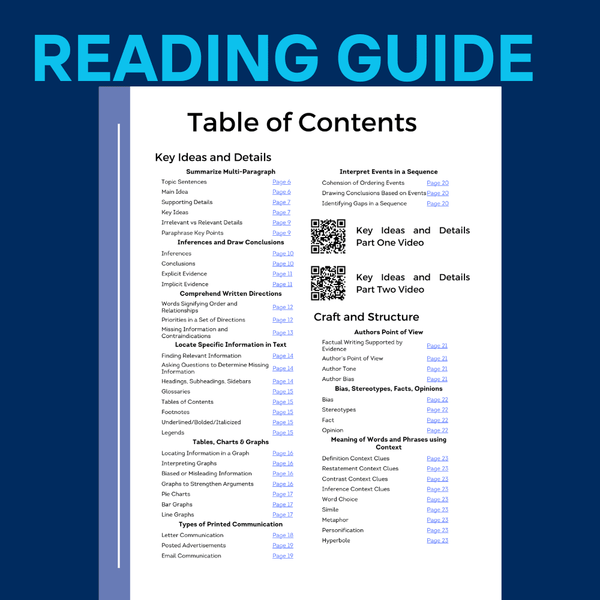
Complete ATI TEAS 7 Study Guide
264-Pages · 2026-2027 Edition · With HESI A2 Add-On
The Complete ATI TEAS 7 Study Guide covers every section of the exam in one 264-page digital prep book. It emphasizes critical reasoning and understanding, enabling effective exam approaches rather...
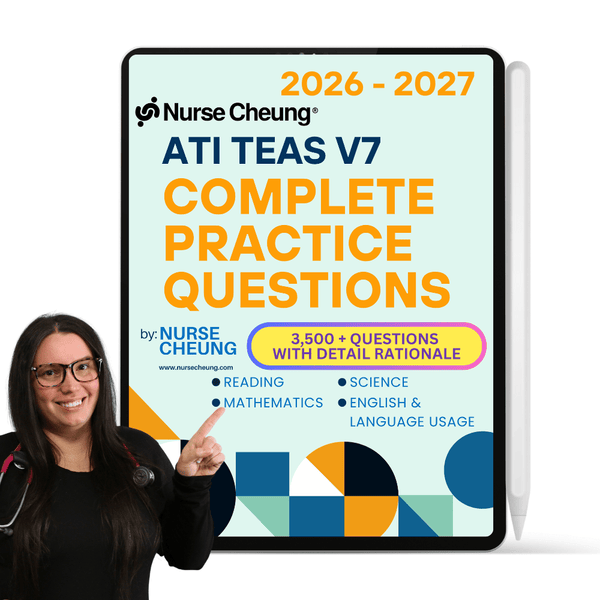
ATI TEAS 7 Practice Question Bank
3,515 Questions · 368 Pages · Sorted by Topic
Reviewing content and testing yourself are two different skills. These 3,515+ questions are organized by subject and sub-topic rather than thrown together as one long test, so you can work...