What clinicals actually are
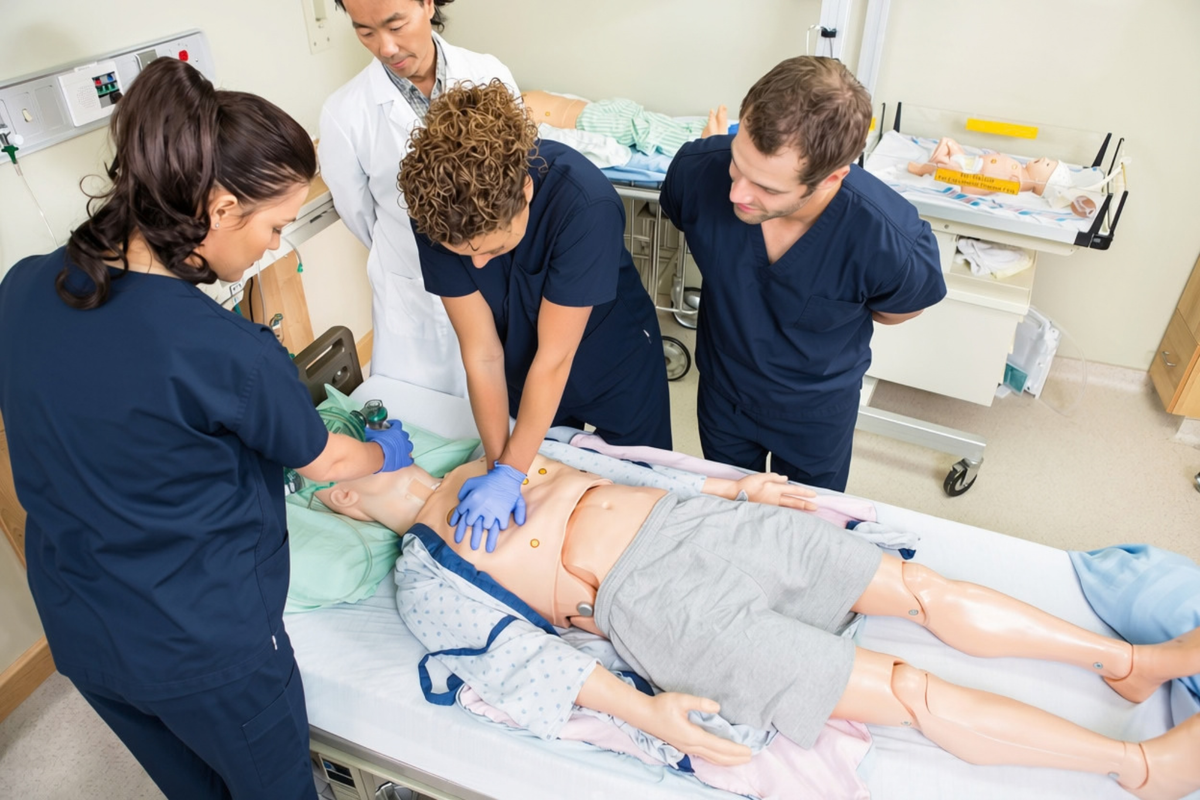
Clinicals are supervised practice in a real healthcare setting. You are assigned patients, you provide care within your scope, and you are observed doing it.
Most first rotations are on a medical-surgical floor or in long-term care. You will usually have one or two patients, a clinical instructor overseeing a group of students, and a staff nurse assigned to your patient.
Days often start early — arriving by six or seven in the morning is common — and run six to twelve hours. There is preparation the night before and usually paperwork afterward.
The night before is where the day is won
The difference between a useful clinical day and an overwhelming one is almost entirely what you did the night before.
Most programs give you your patient assignment in advance. If yours does, research it properly:
|
Look up |
Specifically |
|
The condition |
What it is, what causes it, how it progresses |
|
Expected findings |
What you would expect to see on assessment — and what would worry you |
|
Medications |
What each one is for, how it is given, key side effects, what you monitor |
|
Labs |
Which values matter for this condition, and what abnormal looks like |
|
Equipment |
Anything attached to the patient you have not seen before |
|
Your scope |
What you are allowed to do, and what needs supervision |
You are not memorizing this to recite it. You are building an expectation, so that when you walk in you already know what you are looking for and what would concern you.
If you do not get your assignment in advance, review the common conditions on that unit type instead. It is less precise and still far better than arriving cold.
What to bring
Your program will publish a required list, and it is worth waiting for that rather than buying what upperclassmen recommend. Generally:
- Stethoscope — a decent one you can actually hear through
- Watch with a second hand, since phones are usually not acceptable for counting
- Penlight
- Bandage scissors
- Black pens, more than one
- Small notebook or report sheet
- Pocket drug reference, or your program's approved app
- Student ID and any required badges
- Shoes you have already broken in
- Food and water for a break that may come late
Do not bring anything valuable, and check your program's policy on phones before your first day rather than on it.
How the day usually runs
|
When |
What happens |
|
Before the shift |
Arrive early. Pre-conference with your instructor and group. |
|
Start of shift |
Receive report on your patient from the outgoing nurse. |
|
Early morning |
Assessment, vital signs, morning care, medications with supervision. |
|
Through the day |
Ongoing care, documentation, procedures as they arise. |
|
End of shift |
Give report. Post-conference with your group. |
|
After |
Care plans or clinical paperwork, depending on your program. |
The post-conference is worth taking seriously. It is where the day gets processed, and where you learn from what happened to the other students in your group as well as your own patient.
What your instructor is actually assessing
Students assume they are being assessed on knowledge. They are mostly being assessed on safety and judgment.
|
They are watching for |
Not so much |
|
Whether you are safe |
Whether you know everything |
|
Whether you ask when unsure |
Whether you can answer every question |
|
Whether you prepared |
Whether you are fast |
|
Whether you notice things |
Whether you are confident |
|
Whether you communicate clearly |
Whether you are polished |
This reframes the whole day. A student who says "I have not done this before, can you watch me" is doing better than a student who guesses and gets it right.
The fears, named
"I will be asked something and not know"
You will be, repeatedly, and that is the point. "I do not know, but I will look it up" is a complete and acceptable answer. Guessing is not, because in this setting a confident wrong answer is a safety issue.
"I will make a mistake"
Students make mistakes. That is why you are supervised and why your scope is limited. If something goes wrong or you think it might have, say so immediately — errors that are reported are almost always manageable, and errors that are hidden are not.
"The nurses will not want me there"
Some staff are wonderful with students, some are busy and brusque. It is rarely personal. The way to be welcome is to be useful: answer call lights, help with turns and transfers, and say what you are able to do rather than waiting to be assigned.
"I will be in the way"
You will be, a little, and everyone knows it. The way through is proximity — stay near your patient and your nurse rather than retreating to the break room. Students who hide learn less and are noticed for it.
"Something serious will happen"
It might. Patients deteriorate, and some rotations include death. Nobody expects a student to manage that alone — your job is to notice, escalate, and stay with the patient. If a shift affects you, talk to your instructor, and use your school's counseling service if you need to. That is not weakness; it is what the service exists for.
Giving report
At some point you will be asked to report on your patient, and this is where students most often feel exposed.
Use a structure. SBAR — situation, background, assessment, recommendation — is the standard, and using it consistently is the single fastest way to sound like you belong. Write it down before you say it for the first several weeks; nobody minds the pause.
Small things that make a large difference
- Arrive fifteen minutes early, every time
- Introduce yourself to your patient's nurse and ask how they prefer to work with students
- Write things down — you will not remember them
- Look up a term you did not understand rather than nodding through it
- Say yes to opportunities, even uncomfortable ones — you rarely get a second chance at a procedure
- Eat something before you go, and take water
- Debrief with someone afterward, even briefly
Free night-before prep sheet
We made a one-page sheet for preparing the night before: prompts for the condition, expected findings, medications, labs and equipment, plus a checklist of what to bring and a space to write your SBAR.
Free, no purchase required.
Where this fits
Clinicals are one part of a first semester that changes how you study, how you are examined, and how you communicate. Most programs assume those adjustments rather than teaching them.
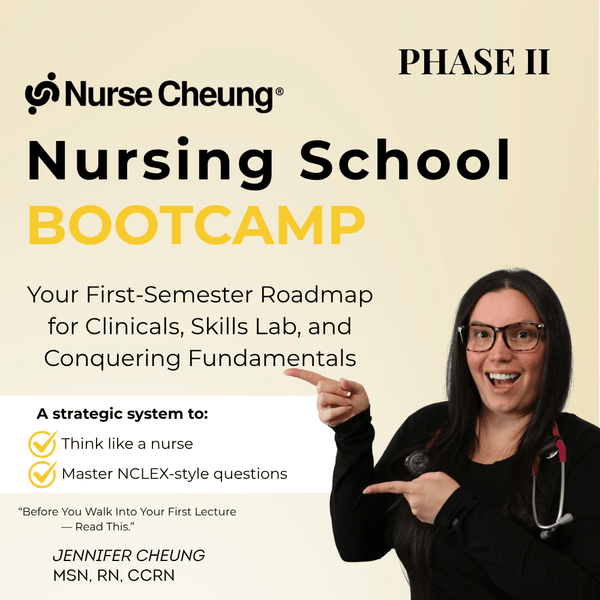
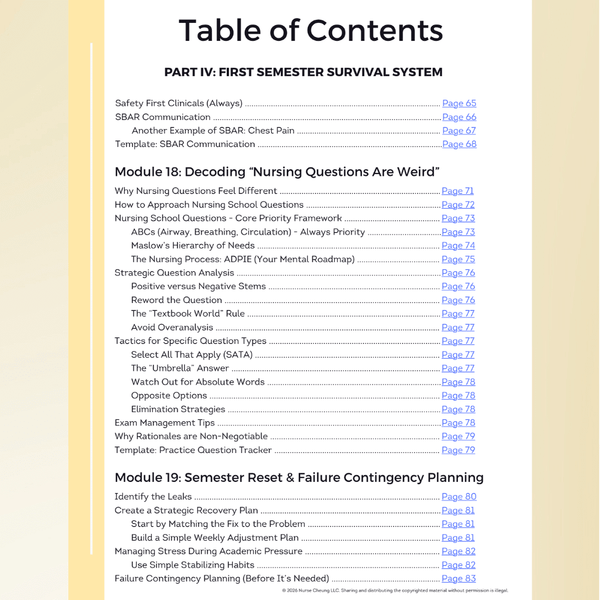
Our Nursing School Bootcamp Phase II covers the first semester across 88 pages, including simulation lab, clinical preparation, SBAR communication, how to study pathophysiology and pharmacology, prioritization and select-all-that-apply strategy, and what to do if an exam goes badly.
Written by Jennifer Cheung, MSN, RN, CCRN. Clinical policies, scope and expectations vary by program and facility — always follow the guidance your instructor and institution give you.
Featured Products
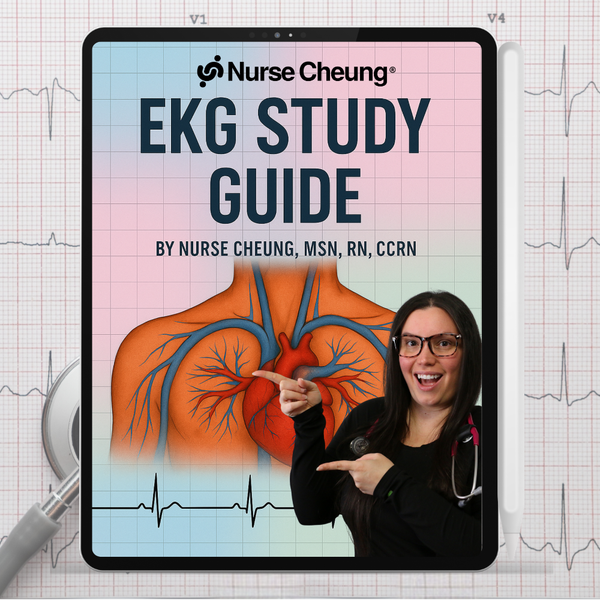
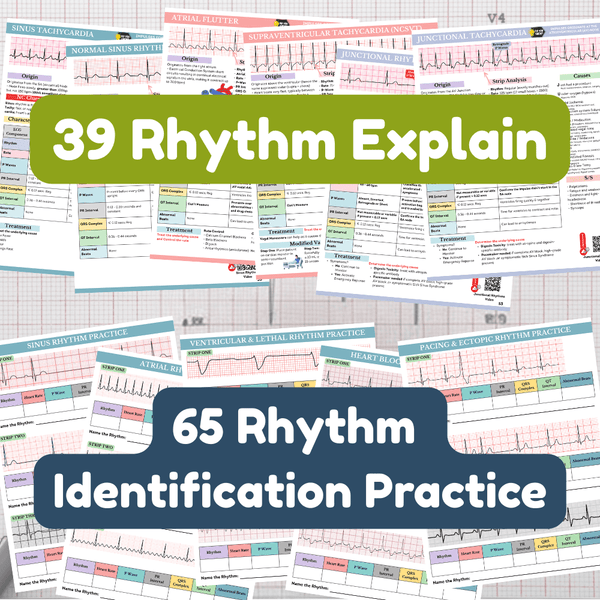
EKG & Dysrhythmia Interpretation Guide
111 Pages · 65 Practice Strips · ECG Rhythms & ACLS
Stop memorizing rhythm names and start reading the electrical story behind them. This 111-page EKG guide (also written ECG) teaches a repeatable method for reading any strip: rate, rhythm, P...
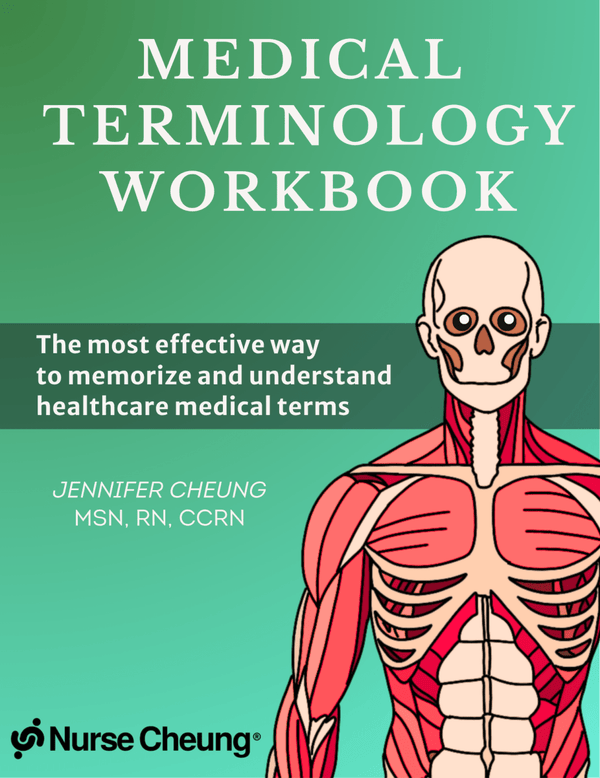
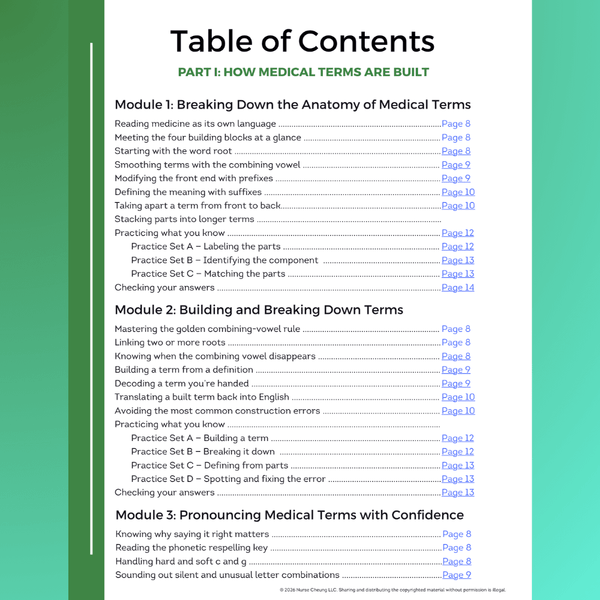
Medical Terminology Workbook
232 Pages · Decode Any Clinical Term
Medical terminology looks like a foreign language because it mostly is. This 232-page workbook teaches you to break terms into their roots, prefixes, and suffixes so you can work out...